
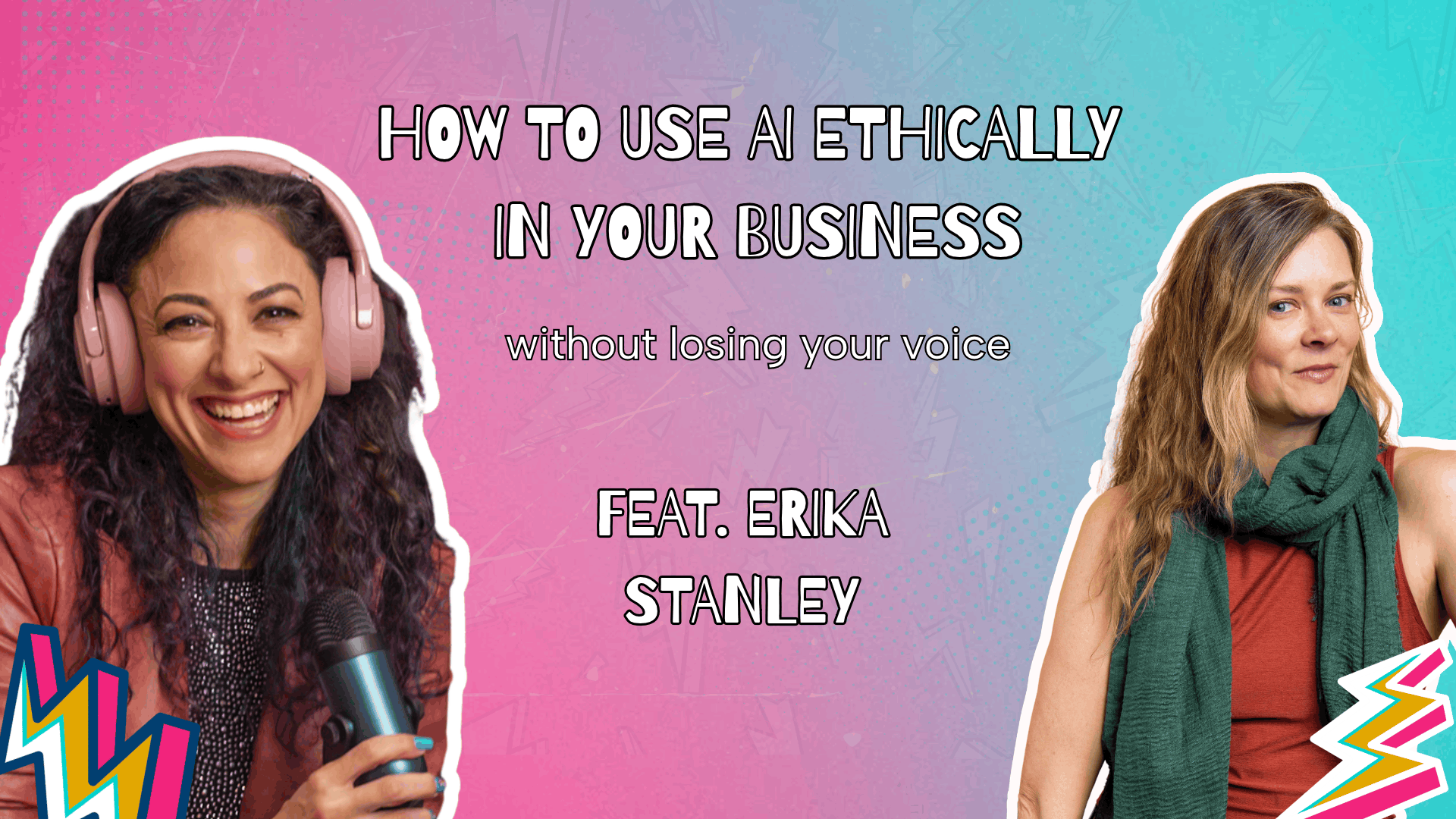
If you’ve ever asked AI to write a caption and gotten back something that sounded like absolutely no one, you know the frustration. And if you care about the planet, about bias, or about the artists and writers whose work trained these tools, you may be wondering whether you should be using AI at all.
On Episode 86 of Bold Women in Business, Rachel sat down with her friend Erika Stanley, brand strategist, host of the AI Queens Podcast, and builder of custom AI systems for women business owners. Together they got honest about what ethical AI actually looks like for small business owners: the real downsides, the real benefits, and how to decide where your own line is.
Read or listen to this episode
Or listen on Spotify | Apple | iHeartRadio
Key takeaways
- Generic prompts get generic results. AI works best when it’s trained on your brand voice, audience, and platforms.
- Ethical AI is not all or nothing. You get to decide which tasks AI helps with and which ones stay 100% you.
- The goal of ethical AI isn’t doing more, faster. It’s getting time back for relationships, family, and the work you love.
- Using AI to find patterns and build systems is very different from having it generate your content.
- AI can be a powerful accessibility tool for people with dyslexia, non-native English speakers, and overwhelmed working parents.
What is ethical AI for small business owners?
For a small business owner, ethical AI means using AI on purpose. You understand the tradeoffs (energy use, bias, and how the models were trained), you decide where your personal line is, and you use AI in ways that support the human side of your business instead of replacing it.
That’s the heart of this conversation. As Erika put it, “Everybody’s got their own line.” Ethical AI is about finding yours.
Being honest about the downsides of AI
Any real conversation about ethical AI has to start with the hard parts, and Erika didn’t shy away from them. She shared that she has a hard time reconciling the energy and data usage, along with the fact that the major models were trained primarily by men and on information and art that was taken without permission.
Rachel feels the same tension. She uses AI all the time and is not in the anti-AI camp, but she also believes it’s possible we’ll look back in a few decades and see it as a net negative for society. She compares it to social media: a tool she teaches and loves in many ways, but one that hasn’t always delivered the connection it promised.
Both agree on one thing. As Erika said, “We can’t put the genie back in the bottle.” So the question becomes how to use AI in a way that lines up with your values.
Can you opt out of AI completely?
You can choose not to use AI, and that’s a valid choice. But Erika offered a helpful comparison: imagine opting out of email entirely. Applying for a passport, registering to vote, almost everything requires an email address now. AI is heading in a similar direction, which is why Erika feels a responsibility to help people understand their options so they aren’t “walking blind” with this tool.
At the same time, Rachel pushes back on the fear-based “use AI or get left behind” messaging. We’re still in the early days, and a healthy level of skepticism is a good thing. Make the decisions that feel right for you.
How to find your line with ethical AI
One of the most useful distinctions from the episode: using AI to generate content is very different from using it to build systems, analyze data, and find patterns.
Erika shared a few ways to think about where AI fits:
- Analysis, not authorship. Back when she was a social media manager, Erika pulled and analyzed analytics by hand. Today, AI can do that analysis for you, even if you’d rather write every post yourself.
- Time-consuming production work. Erika uses AI image generation for branded mockups, like showing a client’s logo on a water bottle or T-shirt. It saves hours and, in her words, “doesn’t feel icky.”
- Running tools locally. Erika builds many of her own tools and runs them on her own computer. If data center use is a concern for you, there are models you can download and run locally.
Rachel shared that one of her prospective students for Bold Content Collective is openly anti-AI. Rachel’s answer: you don’t have to use AI in the course. Every exercise works without it. It will just take a bit longer to process information and find patterns on your own.
Ethical AI is about getting time back, not doing more
This was the reframe that changed everything. So much of the messaging around AI is about hyper-optimization: faster, more efficient, more output. Erika’s response?
“That is not the game, y’all.”
At a recent women in AI conference, Erika mapped out a workflow with sticky notes, looking at where AI could help with a weekly email newsletter and where it absolutely had to stay human. If AI saves you 45 minutes on a four-hour weekly task, that adds up to roughly three hours back every month.
Then comes the real question: what will you do with that time? Go to the gym? Spend time with your family? Erika’s reminder is to protect that time instead of filling it with more work.
Rachel connected this to why most women start businesses in the first place. It’s rarely about becoming a mega millionaire. It’s about a deeper purpose, and ethical AI can help you get back to it.
AI as an accessibility tool
Another side of ethical AI that doesn’t get talked about enough is accessibility.
Erika once worked for a brilliant boss with dyslexia who struggled to get her ideas into proposals and emails. Today, tools like ChatGPT and Claude let her brain dump her thoughts and send emails with confidence that her message will land.
The same goes for people whose first language isn’t English, and for the working mom juggling multiple jobs who just needs to send a quick email to her kid’s teacher. As Erika said, it can be “yes, and.” Yes, AI was trained with bias and uses a lot of resources, and it’s also opening doors for people who wouldn’t otherwise have access.
What ethical AI looks like in real life
Erika shared three examples of AI systems she’s built:
- A podcast repurposing system. Erika’s tool connects to Descript, pulls her podcast transcripts, and turns them into short video clips, social posts, emails, and blog content. It gets her about 80% of the way there. Her VA, whose first language isn’t English, uses the system to finish the content. It’s Erika plus AI plus another human, which is the opposite of “AI is taking our jobs.”
- A dental office content system. For a busy dental office in Austin, Texas, Erika built a process where a front desk team member interviews a doctor for 15 minutes over lunch using a question bank. The audio goes into Dropbox, and an automation built with Make.com and ChatGPT turns it into content, without adding to anyone’s workload.
- Custom tools instead of subscriptions. Erika has canceled $1,200 a year in software subscriptions by building her own tools that do exactly what she needs, nothing more and nothing less. She even built a system to handle her invoice messaging, because she hates sending invoices.
Her guiding principle: “It is a tool, not a crutch.”
Why AI gives you generic results (and how to fix it)
If you’ve ever dropped a blog post into ChatGPT and asked for an Instagram carousel, only to get something bland back, there’s a reason. The tool hasn’t been trained on you.
Erika’s systems include detailed instructions about brand voice, audience, platform-specific hooks, and formats, because a LinkedIn post and an Instagram carousel need different things. And she updates them regularly, because what worked on LinkedIn a year ago doesn’t work now. None of this is set it and forget it, and it wouldn’t be with a human team member either.
That’s why Erika starts every client with her Brand to Bot Blueprint, a three-part framework that looks at:
Your external visibility: how to take the genius you’re already sharing and put it in more places where people can find you.
Your brand: what makes you, you, so AI can sound more like you.
Your internal systems: what can be streamlined, systematized, and eventually handed off to a team member or to AI.
Frequently asked questions about ethical AI
Can you use AI ethically in a small business?
Yes. Ethical AI in a small business starts with knowing the tradeoffs, choosing which tasks AI supports and which stay fully human, and using the time it saves for things that matter to you, not just more work.
What are the biggest ethical concerns with AI?
The concerns raised in this episode include energy and data usage, bias in how models were trained, and the use of creators’ work without permission. Both Rachel and Erika believe it’s important to acknowledge these openly.
How do I decide which tasks to use AI for?
Map out a workflow step by step. Mark the places where AI could help (like analysis, organizing ideas, or production work) and the places that need to stay 100% you. Your line can be different from anyone else’s.
How do I make AI content sound less generic?
Give AI context before you ask for content: your brand voice, your audience, and what works on each platform. Then review and adjust over time.
Does using AI mean replacing people?
Not necessarily. In Erika’s business, AI helps her VA do work she wouldn’t have felt confident doing alone. Used well, AI can support people instead of replacing them.
Connect with Erika:
- Website: aiqueens.com
- Instagram: @erikatheaiqueen
- LinkedIn: Erika Stanley
- Podcast: AI Queens
And while you’re here, take Rachel’s free Content Marketing Power Type Quiz to find out what kind of content will actually help you grow.